



Lyon & Provence Cruise on the Viking Delling
3/26/2024 to 4/6/2024
Click on the above link buttons that will take you directly to a particular page or area of the review; or you can just click through to the next page at the bottom of each page.
Page 1 – Embarkation, Ship, Cabin, Entertainment, Activities; Ports of Call: Avignon, Arles
Page 2 – Ports of Call: Avignon, Vivieres
Page 3 - Ports of Call: Tourmon, Lyon - Day 1
Page 4 - Ports of Call: Lyon - Day 2, Paris Extension Day 1 & Day 2
Page 5 - Ports of Call: Paris Extension Day 2 (Continued) & Day 3-4
Day 3 - Avignon
We woke up in Avignon on Good Friday. I was so happy to finally be able to enter the gates of the town that I didn’t have time to enter two days earlier. I was concerned that we might not be able to visit some sites due to this holiday and on Easter two days later. We were quite pleased that the holidays had no effect at all on our touring. We had two tours for our day in Avignon. The first one was a walking tour of the city with a wonderful guide named Ghistane.

We walked across the street from the ship where Ghistane told us about the walls of the city that were built in the 14th century that I took photos of the first day. This was the time when seven Popes ruled from Avignon at the Palace of the Popes we would visit.
We walked through the old narrow streets that were surprisingly empty. With it being Good Friday, people must have stayed home in the morning. Ghistane pointed out the paintings in two windows on a building. This is a popular thing to do. We would see more.


We saw the 14th century Church of Saint Agricol. I got a kick out of the harpies on the corners of the church. We didn’t go inside, but not because of the harpies.


It was a pretty and interesting town to walk around.


We came into the town square. On one side was the town hall where the flags of the EU, France and Avignon were displayed.


At one side of the square was a two-level carousel.

I liked the painting on another window.

The current Avignon Opera House was built in 1846 and is still in use. I liked the statues on either side of the stairs.


Near the opera house, I was able to see the city’s beautiful clock tower. Because of its location, you can only get photos of the whole tower from above. But the top is the best part of it.

We next headed to one of the ten most visited monuments in France, the Palace of the Popes. It is actually two separate palaces that have been combined into one. It is heavily fortified with ten-foot-thick walls. Pope Clement V moved to Avignon in 1309, 4 years after his election as pope. Rome was not happy to have a French pope, so he moved to Avignon to escape the violent chaos. The palace was built by later popes that followed Clement V. It is the largest Gothic palace in Europe with 160,000 square feet of floor space.


Next to the palace is the Cathedrale Notre-Dame des Doms. The gilded statue of Mary on top of it is an eye catcher.


Ghistane told us that the palace is basically empty rooms since everything was moved to Rome when the popes left Avignon. We were allowed to take photos everywhere except for a couple rooms where there are paintings on the walls. A fire in the palace destroyed many of the frescos on the walls. We walked into a large foyer where we then moved to a courtyard where the tour would start.


The first room was quite large with a scale model of the palace at one end.


They also had a couple of the original doors on display.

We were able to take photos of a couple of the frescos on the wall.

Another room had a wood beamed ceiling and nothing else to look at.

The next room was very long dining room with a wooden domed ceiling. A large fireplace was at one end.


On one side of the room there was frescoed chapel behind a thick plastic barrier. Ghistane said I could take photos of it without flash. With the barrier being plastic, the reflection of the ceiling lights took away from the photo, but I did want to show what it looked like.

The room next to the dining room was the kitchen. The 60-foot-tall chimney was most impressive. This room was able to roast 50 oxen at one time.


The next room was the Conclave Room where the cardinals would meet to elect a new pope.

Another room was the north sacristy. It contained some beautiful stone effigies.


The next room, I believe, was a large chapel.

Close by was the pope’s bedroom which was still fully painted with gorgeous floors. It was far enough from the fire to be saved. I wish I could have taken photos to show you.
We then came to the room where the pope would stand at the window and bless the people and/or make announcements. It now looks out into a courtyard that is used for different events.


The last room was the grand audience. It was quite large. There were a couple of very vivid frescos on the ceiling.


We left the palace and continued the walk through the lovely town. So many beautiful buildings.


As we were walking to our next destination, we passed by the Basilica St. Pierre. Before the cruise, I marked it down as a place I wanted to visit while in Avignon. Ghistane said that an inside tour was not on the agenda, so I planned to return when I could.


We next saw the Avignon Synagogue. It was built between 1846 – 1848 after the older synagogue was destroyed by fire. Once again, we were not able to go inside due to the tour time restrictions. I have found that the Viking tours leave out most interior visits to religious buildings. I can understand why, but for me, I need to go inside to get photos of the beautiful places.

As we got closer to our destination, we could see the St. Jean Tower that was built in the middle of the 13th century.

Ghistane was taking us to Les Halles, the large market in Avignon. The whole side of the building was covered with plant life. Kind of cool!

We had 20 minutes to shop in the market or do anything else we were interested in. Cathy went into the market, and I headed back to Basilica St. Pierre. I needed to see the inside. I’m glad I did, since it was a lovely one. The paintings were gorgeous.


I particularly liked the stained glass.


With the limited time, I hustled back to Les Halles to quickly check it out. It looked like a typical covered city market to me, but they did have some very nice-looking meats and produce.


As we headed back to the Delling, we saw more lovely streets, buildings and statuary.


We went back on the ship for lunch. After lunch I had about a half hour to look around the area until our next tour. One of the places I wanted to see was the St. Bénezet Bridge. It was built in the 12th century. It lasted until 1668 when a flood knocked down most of the half-mile-long span. Just a small section remains. Rafeal told us that it was only about a five-minute walk to see it, so I headed that way. I was distracted by the beautiful town of Avignon at a different angle than I had previously seen.

It wasn’t long till I could see the remains of the bridge. There is a charge to walk out on the bridge. I really didn’t care about doing that, plus I didn’t have enough time. We were told that we would pass by the bridge when we left Avignon. I was glad that I came when I did since we didn’t come by it. We went south to take a shorter route on the west branch of the Rhone.
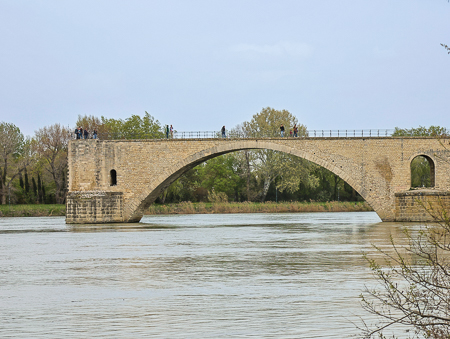
On the way back I took more photos of the skyline and some swans on the river.


That afternoon we had an optional tour called Châteauneuf-du-Pape Wine Tasting. The area close to Avignon is well known for its fine wines. There are 325 wineries in the Châteauneuf-du-Pape region. It covers 7,900 acres. There are 6,000 wineries in the whole Rhone Valley area. Our tour guide was Emanuel. He was quite a character and quite fun loving.

We were too early to see grapes growing on the vines, but we could see the vines themselves. We stopped to see how they grow in the rocks. These rocks were at one time on the bottom of the Rhone River. Over thousands of years, this land moved up and the rocks remained. The rocks benefit the vines by keeping the temperature moderated.


We next went to a viewing area high up on a mountain. The ruins of the 14th century chateau were still standing after seven hundred years.


We walked around it to see a view of the valley and Rhone River from there.


We next went to an area where they had several different grape vines with descriptions of them. With the grapes not there, it wasn’t as interesting as it could be.


It was then time for the wine tasting. We drove to the Maison Bouachon winery.


We went into a room with large vats and barrels. They told us about their wine making process.

We next went to the tasting room where we were seated at tables. Each person had three glasses of wine to taste along with bread, two types of olive tapenade and a cheese sauce. We were told about the different wines and how to evaluate them through sight, smell and taste. It was a nice lesson on how to appreciate wine. They were quite good, even for my rookie wine skills.


We got back to the ship around 6:00 PM. We immediately pulled away from the dock for our next port, Viviers. It had been a very full day with great weather. We were lucky so far with the weather and hoped it would continue, even though the forecast didn’t look that good in the coming days.
Day 4 - Viviers
The ship was supposed to arrive in Viviers at 1:30 AM. Since we were asleep at that time, we didn’t know when we arrived, but we were there in the morning. Unfortunately, the weather forecast was correct, and the rain was pouring down. We were glad that our Viviers walking tour didn’t start until 9:45 AM. Perhaps the rain would let up some. It did, but not enough. Our tour guide was Ginette. She was a real trooper. Even with the rain she had a very positive attitude and helped us to enjoy the tour.

Viviers is a small town of less than 4,000 residents. We began our walk along a road lined with trimmed down plane trees. It must look quite nice when they are fully grown and blooming.

The town looked rather nice. The wisteria added a nice touch.


When we got further into town, we saw a tall shear mountain ahead of us. I was glad we weren’t going to have to climb that. Ginette didn’t tell us that we actually would be going to the top of that mountain. It was the right thing to do since some people might have just gone back to the ship if she had told them. It wasn’t a bad walk at all. I don’t know why, but we didn’t have any long steep climbs journeying up to the top.

Even with our umbrellas, we were getting pretty soaked. Walking through the narrow medieval streets was most enjoyable. It would have been much better without the rain. As you can see from the below photos, there aren’t any steep inclines that we walked up. It just gradually got closer to the top. There were a few areas where we had to take some steps up but not that many.


We came to a building that had paintings on the walls that looked like they were shops.


As we got closer to the top, we could see our final destination, the Viviers Cathedral. Construction started on it in the 11th century and was completed in the 12th.


As we got closer to the top, we had some great views below of the valley and the town.


We finally got to the smallest cathedral in France.


The interior was simple, but elegant in its simplicity.

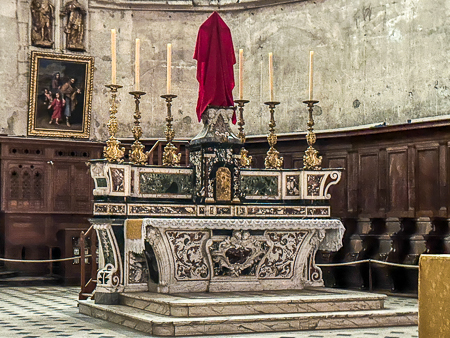


While we were in the cathedral, the rain let up a bit. The walk back down the mountain was most enjoyable with the beautiful buildings and narrow streets.


When we were back in the lower town. Ginette told us to look back at the mountain. She then told us that it was what we had just climbed up. No one could believe it, since it was a very mild incline, and we were distracted by the town’s beauty.

When we got back on the ship, my Apple watch started beeping at me. I looked at it and told me too clear it of water, which is something that needs to be done after swimming normally. It then asked if I wanted to record a pool swim. We thought it was hilarious that we had gotten so wet during the tour that the watch thought I’d been swimming. The sleeves on my puffy jacket were totally drenched which probably confused the watch.
We had lunch and the ship left for the next port, Tournon, at 1:00 PM. We wouldn’t arrive there until 10:00 PM, so we would have an enjoyable afternoon of scenic cruising. I was worried that the rain might make the cruise less scenic, but it stopped by the time we left Viviers.
I went to upper deck to take photos. Since we would be cruising under some low bridges, the supports for the canvas shade coverings, railings and any tall equipment were all lowered. The front part of the deck was also closed so the only area to walk around was the back half.


I decided that it would be more comfortable to sit in the lounge and watch the world go by. If I saw something that I needed a photo of, I could just walk out onto the open front deck. While watching a swan swimming in the river, two large dogs came running along the beach. They stopped at the swan and were most interested in meeting it. One dog tested the water and decided that it might be best to meet it another time.

Unlike the Rhine and Danube, there weren’t as many villages or castles to see. We finally did come to one medieval village that had the ruins of a castle on a mountain nearby.


Further up the Rhone we saw what appeared to be white smoke rising. As we got closer, we saw that it was the steam from the Cruas Nuclear Power Plant’s water-cooling towers.

It is a large facility that provides 5% of the total energy production in France.


As we passed by the last cooling tower, I looked back to take some more photos and was surprised to see a massive mural on the side of the last one. It is titled Aquarius. It reflects the basics of water and air. They hired nine mountaineers to help paint the tower. It took 8,000 hours and 1,100 gallons of paint to complete.

A half hour later we pulled into a very high lock. We were told that between Avignon and Lyon the Rhone increases 900 feet in elevation. I enjoy watching the lock process a time or two on a cruise and then it gets to be just another lock. I am always fascinated at how little room there is on the side of the boat. Of course, the river boats are designed as wide as possible to fit in the narrowest locks they will pass through, but it still takes a lot of skill to not bang up against the walls.


About a half hour out of the lock, the ride became more interesting. The terrain was more mountainous, and we were passing by small towns. It was a much prettier part of the river.


We eventually came to our interim stop in the town of La Voulte-sur Rhone where we would pick up those that went on an optional excursion rather than the included Viviers walking tour.


The red bud trees were in full bloom. On the dock was cute model of a large bird.


The Delling then continued to our next port, Tournon. We were supposed to arrive at 10:00 PM. That night at dinner the dining room staff brought me a birthday cake and sang the birthday song to me. The cake was a very delicious passion fruit cheesecake. We had it cut it into five pieces, since we were dining with our three new friends from Australia.


© 2024 ThePreismans.com • All Rights Reserved